

The Cricket and the Ant
Text & Illustrations: Annelie van Steenbergen
What would we do without art and culture? The answer to this rhetorical question becomes particularly clear in times of war. In stable societies, artworks are often seen as luxury items, but once they are destroyed or banned, their essential nature is revealed. The destruction of monumental sites and cultural heritage strikes a population deeply in the heart. Centuries-old traditions are obliterated in an attempt to deprive a nation of their tangible history and identity. It is no coincidence that poets and singers pass on their stories, sometimes in secret, in the hope that at least the oral art will be preserved and transmitted. This can concern fundamental themes such as fear of death and the search for love and meaning, or the question of how to live well. Even criticism of dictators and power structures can be concealed in artistic expressions. Artists also provide much-needed distraction and relaxation through dance and music. Art and culture are therefore crucial for the emotional and physical well-being of a population.
Traditionally, stories were passed down orally and in song long before they could be written down. This has given us a large number of heroic sagas, tales of gods and mythical stories. No act of war anywhere can change that. The animal fables of Aesop (620-500 BC) are also an example of ancient stories, in this case with a moral basis, which are still being retold. Who does not know the fable of the Grasshopper and the Ant? Even our very youngest children are already presented with this fable in animated films.
The ant and the grasshopper [1] stands as one of the very last in the collection of Aesopian fables, which ‘Romulus’ compiled around the fifth century. Seventy-seven other interesting fables precede it. The fact that this particular fable became so well known is thanks to Jean de La Fontaine (1621-1695), who published it as La Cigale et la Fourmi, translated as The Cricket and the Ant [2], right at the beginning of his first collection (1668).
Like most of Aesop’s fables, this one also opens with a moral lesson, the promythium, which the reader should take to heart:
‘She teaches us that it is wise to gather in the summer so that one can live well in the winter, as you can see from this fable.’
He supports his moral with the following simple story. A little grasshopper goes to the ant in winter and asks her for some grain to eat. The ant asks him what he has done during the summer. The grasshopper replies that he has been singing. The ant slyly suggests he might as well dance in the winter and refuses to give him a single grain from her store. That is all.
Except that there is a concluding moral, the epimythium:
‘That is why everything has its time, for those who do not work with their hands often have to shiver.’
Those who do not work will not eat either. He should have been more diligent, should have saved for hard times. It is a fable about the importance of thinking ahead and working hard versus laziness.
Jean de La Fontaine turned it into a beautiful poem in his time and at the same time slightly adjusted the moral.
‘Cricket, who had delighted in singing all summer long,
saw with dismay that autumn had arrived:
not even a little worm,
wherever she looked,
that could appease her hunger…’
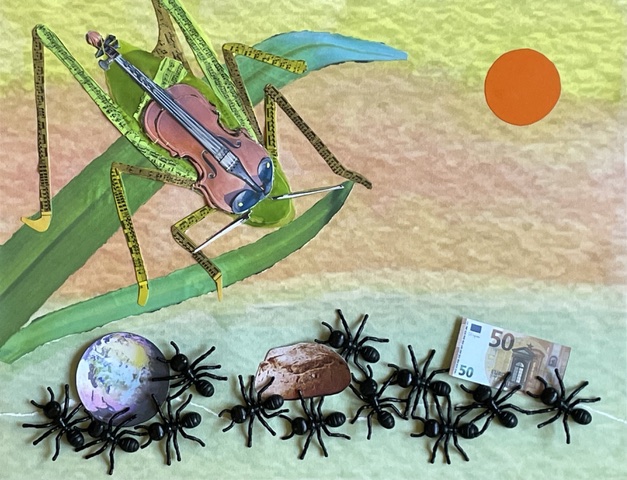
The starving cricket expects that the ant, of all people her neighbour, will lend her some from her plentiful supply. She only needs until spring and then she will repay her with interest within a year. She is in for a surprise, as the ant delicately asks her what she has been doing during the long summer. La Fontaine puts it euphemistically: ‘what ant left to be desired for, borrowing was not her weakness.’ He clearly means that she is stingy, though he does not want to say it aloud. He lets the cricket reply that she has sung faithfully with all her might day and night. That is something, you might think, but the ant is unimpressed. Like Aesop’s ant, she mockingly advises her to go dance now. La Fontaine also ends with an epimythium:
‘Do not be careless! If you see,
Egoists do not help.
“Good advice?” – Oh, dear man,
Good advice, who eats that?’
In this final verse, there is much to read. You should not be careless, because you cannot expect help from egoists. He is thereby explicitly stating that people who do not help are selfish. In other words, they have little empathy and do not consider the feelings and needs of others. That is strong criticism. We have already seen that he finds the ant miserly. Moreover, he complains that he is not paid for his advice.
Here we arrive at the question of why Jean de La Fontaine found this fable so relevant that he chose to versify and publish it first. The answer may be that he felt a kinship with the cricket. He himself was a cricket!
La Fontaine was born into a fairly well-off family. His father supported him in his literary ambitions and passed on his own forestry position to him, so that he would have work and an income alongside his poetic aspirations. He married, had a son, and then abandoned both to make a name for himself in Paris. He befriended important French writers, neglected his work, and squandered his capital. Because he possessed not only talent but an exceptionally pleasant character, he was offered shelter and maintained by cultured ladies who enjoyed his kindness, sincerity, and gentleness [3]. He was a somewhat dreamy man, very well read, and a welcome guest in the literary salon of the wealthy Marguerite de Sablière (1640-1693), who took him under her wing for twenty years.
Besides the immensely popular fables, he wrote mediocre poems, operas, comedies and novels which have now faded into obscurity.
After her death, he again fell into financial difficulties and lived in impoverished circumstances. He became seriously ill, turned to the church and read the Bible. Possibly also the quote from Paul’s letter, in which the apostle admonishes the believers: ‘If anyone will not work, then he shall not eat.’ [4] He burnt a play and regretted his often rather obscene Tales. He recovered from his illness and was taken in and cared for out of compassion by friends until his death in April 1695. The last part of his Fables appeared in 1694, when he was 74 years old. Truly a real cricket, an artist who lives for poetry, thinking not of the future, dependent on the generosity of his friends.
However, we must remember that a cricket, like the grasshopper, is not as carefree as it is often portrayed. Firstly, most crickets only have a short period during which they can display their skills. The rest of the time is all preparation. They survive many winters as eggs underground. When they hatch in the spring, they are tiny crickets that must moult four to ten times before reaching adulthood in the summer. With each moult, their wings, which they will eventually use to make music, grow slightly longer until they are fully developed. The females can then lay their eggs, and to attract them, male crickets make music by rubbing one wing, which has a serrated ridge, against the other. This is called ‘stridulation’. A grasshopper uses its leg as a bow, giving it a slightly raspier sound. Once adult, they often live for another 8 to 10 weeks. However, we must remember that a cricket, like the grasshopper, is not so lazy. On warm summer evenings, we can also enjoy their chirping. So hard work is required to achieve the intended musical result. There is no question of laziness.
Even in our adult world, hard work is necessary before an artist reaches the level at which they can perform in public. From a young age, hours are spent every day practising their instrument, sponsors (usually the parents) invest in expensive lessons, and the whole life is focused on perfecting technique and performance. The same applies to other forms of art, such as dance, theatre and visual arts. There is no achievement without continuous effort and dedication. Someone who sees a writer walking dreamily through the park would not suspect that their mind and heart are engaged in a complex conceptual creative process. This is not visible to the outside world.
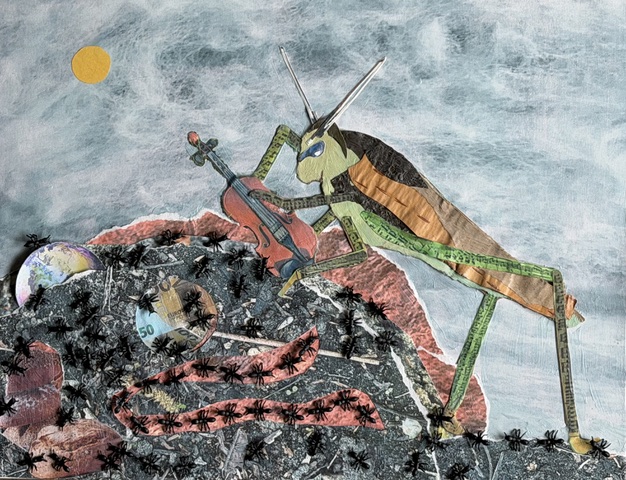
No wonder that Aesop chose the neighbour Ant as a counterpart in his fable, because at the other end of the spectrum, we have the hard workers in ant colonies. Not a single ant could think of idling or giving up. An ant is born to toil and cooperate. She has an inner drive to be useful to the community through caring for others, building homes and maintaining roads, and by producing and gathering food. It does not take much imagination to consider what happens to the poor little ant that shows creative tendencies.
Nowadays, the moral of this fable is often interpreted differently than in the past. The first signs of this are already present in La Fontaine. In earlier times, the ant was mainly admired, whereas nowadays we look more critically at her behaviour. Shouldn’t the ant have taken some action to save her neighbour from starving?
In children’s films, for example, the fable is now explained in such a way that the ants do help the grasshopper through the winter, but at the same time, they urgently advise him to prepare well for the cold and the lack of food in nature the following year. Of course, the grasshopper promises to do so. The fact that it is not in his nature to be thrifty, and that he lives only for one year, so he will not be there next year to repay his debt, is wisely left out of consideration.
This fable is about the contrast between the labourer and the musician. Or perhaps it is about the contrast between the responsible person and the freeloader, who deliberately exploits the kindness and resources of their neighbours and acquaintances? Even in that case, we cannot abandon someone in need, keeping in mind the proverb: Too much kindness is the neighbour’s folly.
Like most fables, this fable is also an example of a political issue, which can be contemplated deeply and over a long period to determine one’s own stance. From the past to the present, philosophers have engaged with this topic. Not that they were or are generally against art and beauty in themselves, but the function and relevance of art, and particularly music, has historically been and continues to be controversial.
Consider the decline of music schools, the reduction in art subsidies and the years of budget cuts in the cultural sector, which increasingly force professional artists to also be entrepreneurs and experts in social media, such as TikTok, YouTube and Spotify. Or they are compelled to take on a part-time job outside their field.
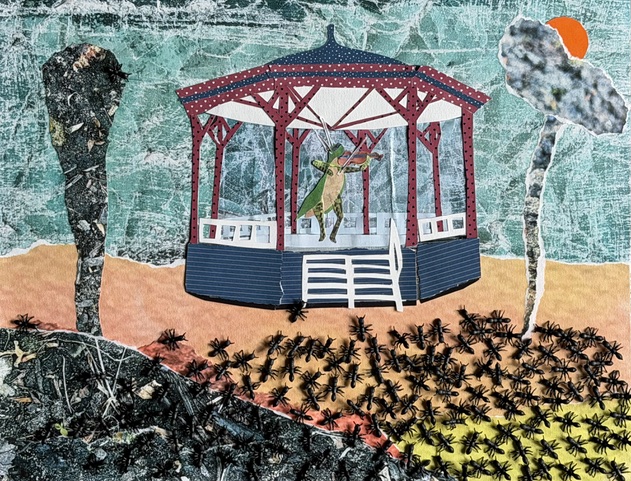
On the one hand, we cannot imagine a society without artistic, literary and architectural traditions and developments, and on the other hand, the money for them must come from somewhere. So let us be grateful that in our world we have both crickets and ants. Artists and audiences are inextricably linked. A connection that contributes to a well-functioning community and endures and thrives through mutual recognition and appreciation. Well-founded criticism must of course always be possible, but that does not detract from the fact that, in times of need, a little extra can be given according to capacity.
Fables encourage us to reflect on these matters and to find and seek our own place in the world and the political spectrum. By reading and contemplating fables, we learn that the stance of an age-old moral holds the potential to broaden the debate and push boundaries in line with our feelings and views at a particular time and stage of life. And the latter is meant literally, for fables are not only enjoyable and instructive for children of all ages, adults, both young and old, can also use them as a whetstone for the mind.
Noten
[1] Het leven en de fabels van Esopus. Teksteditie met inleiding, hertaling en commentaar door Hans Rijns en Willem van Bentum. Hilversum: Verloren, 2016, p. 267.
[2] Jean de La Fontaine (nagevolgd door J.J.L. ten Kate) De fabelen van La Fontaine. Amsterdam: Gebroeders Binger. 1875 (?) (1e druk). Geïllustreerd met platen en vignetten door Gustave Doré. Fabel I, eerste boek, pp. 3-5.
[3] Jean de La Fontaine (nagevolgd door J.J.L. ten Kate) De fabelen van La Fontaine. Amsterdam: Gebroeders Binger. 1875 (?) (1e druk). Geïllustreerd met platen en vignetten door Gustave Doré. Het leven van La Fontaine, p. III-X.
[4] Bijbel (2 Tessalonicenzen 3:10).