As a child, I thought for a while that I could sing beautifully. To my own ears, my singing sounded pleasant and pure. Apparently, no one in my family agreed, as I never once received a compliment. Something like, “Wow, you sing so nicely! Don’t you want to join the children’s choir?” My mother, aunt and grandmother often sang beautiful songs from Schubert’s Liederbuch, with my mother accompanying the trio on the piano. The competition was so great that my poor singing abilities paled in comparison. No wonder then, that I could easily imagine the position of the raven in the fable The Raven and the Fox.[1] I felt deep sympathy for the poor raven, who was made to look so foolish. I could have been that raven myself.
Many people know this fable, in which a raven is tricked by a cunning little fox. Not only because the story is widely used in education, but also still often cited in children’s books and adult versions. Notably, it is listed as the second fable in the thick collection of the works of the famous poet Jean de la Fontaine (1621–1695), immediately after the other classic, The Cricket and the Ant. La Fontaine had taken these fables from the ancient Greek storyteller Aesop (620-500 BC).
The Raven and Reynard the Fox by Aesop was passed down as the fifteenth fable by a certain Romulus, somewhere between 350 and 500. He is said to have translated the fables from Greek into Latin. In the works of Aesop and Romulus, it was not customary to call a fox ‘Reynard’. He only received that name in the Middle Ages following the popular epic Van den vos Reynaerde, after which this name was added to the fable in the first Middle Dutch translation of 1485. [2] Romulus introduces the fable as follows::
‘It happens to those who allow themselves to be overloaded with the flattery of flatterers and who believe the flatterers, often that they later regret it greatly. Esopus tells the following fable about this.’
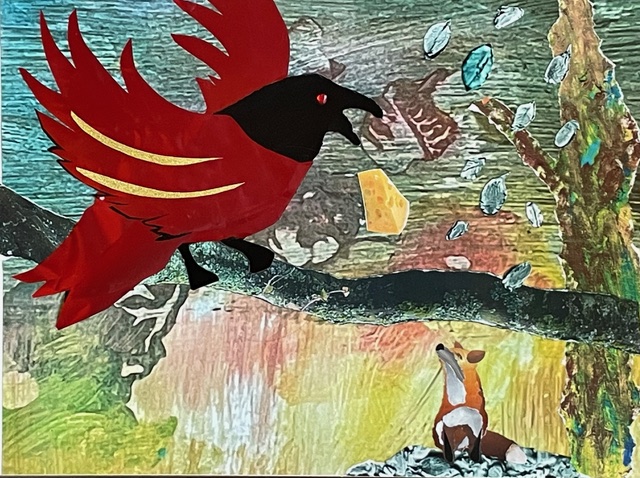
In this well-known story, the raven is sitting in a tree with a large piece of cheese in his beak. The fox Reinaert fancies it and devises a trick to snatch the cheese from him. He politely addresses the raven and starts to coax him with flattering words:
“Finally someone who recognizes his talent.”
‘O beautiful raven, you are the most beautiful of all birds, for you have the most splendid feathers and you can sing exceptionally well. If you had a clear voice, you would be the happiest of all birds.’
The raven allows himself to be flattered by the clever fox. Finally, someone who recognises his talent he thinks to himself. He opens his mouth to give a demonstration of his singing skill, causing the cheese to fall from his beak, which Reynard then steals. The raven realises he has been deceived and remains sad and disillusioned, full of regret for having been seduced by the flattery of the clever fox.
Aesop ends this fable with the following moral:
‘Therefore, this fable teaches us not to take pleasure in the words of wicked people and not to be swayed by flattery or vain glory.
Later on, La Fontaine takes Aesop a step further. Besides putting the fable into rhyme, in The Raven and the Fox, he exaggerates the fox’s flattery to the point of absurdity. First, Reintje addresses the raven as ‘Honoured Lord of Ravenhorst’ and then speaks in superlatives, even comparing the raven to the Phoenix, certainly if his voice could match his rich plumage. The Phoenix, referring to the legendary miraculous bird, who rose from fire, with flaming red and brilliant gold feathers, flying lofty like the mighty eagle. The raven feels so flattered and challenged that he decides to make his voice heard. With the familiar result: gone is the cheese, gone is the precious prey.
“Away cheese, gone is the precious prey…”
The fox enjoys the tasty morsel and, while demonstratively licking his lips, rubs the raven’s loss in even more. The raven, already mortified that he fell for it, gets free advice from the fox:
“Know, friend! Flatterers croon
To trick their listeners.
Such a lesson, by my tail!
Is surely worth a piece of cheese.”
Unlike Aesop, who makes the raven mourn the loss of his precious possession without any further consequences, La Fontaine makes him fly into a rage and swear that he will never listen to flatterers again in his life. This raven learns from his experience. And La Fontaine then concludes that although this is good, it comes a little late.
In schools, this fable is read to teach children what a moral is, a wise lesson that tells you how to behave properly to avoid getting into trouble. It highlights the importance of values and norms, such as being sensible and honest. We need not only empathy and care, but also a healthy dose of mistrust to recognise swindlers and thieves. The wise lesson of the Raven and the Fox seems simple: do not listen to flatterers, because it will cost you dearly. The foolish raven listens to the clever fox and thus loses his valuable piece of cheese. He shouldn’t have been so stupid. Good lesson.
Is it really that simple though? On closer inspection, it is not at all easy to put this wise advice into practice. In this fable, the fox is the mischievous and clever rogue, evoking a smile and even sympathy. The raven plays the role of the foolish fool who falls into the trap through vanity and overconfidence. Ravens already have a rather bad reputation. They are symbols of doom and malice. They are seen as prophets of catastrophe, predictors of death and destruction, and they are unclean, true scavengers. On the other hand, this member of the crow family is considered by ornithologists to be one of the most intelligent birds in the world. They are playful, have an extraordinarily good memory, and are even able to use tools, such as sticks to extract food from holes or stones to crack nuts. It is also known that they can cooperate, for example, by leading wolves to a dying prey, so that they can grab a bite once the wolf has torn the carcass apart for them. In other words, the raven is not a fool that you can deceive. He is far from stupid, plotting how he can grab a bite once the wolf has torn the carcass apart for him. In other words, the raven is not a fool you can deceive with anything, he is far from stupid.
What then could be the case? In the fable, the crow is complimented not only on its shiny plumage but also on its voice. The crow does not immediately dismiss this, for he thinks: that could very well be true. In the taxonomic system, once developed by the 18th-century scientist Carl Linnaeus, crows are indeed classified in the order of songbirds. Songbirds! It makes sense that he expects he can indeed sing. Only, he has never been praised for it and doubts his talent. The fox is the first to appear to acknowledge his ability, and his flattery thus fuels his ambition.
Yes, indeed, he is the bass in the bird choir! With his deep, heavy ‘kròòònk’ he provides the essential foundation for a full sound. He is a master at producing all sorts of different sounds, not just the raw ‘kroa-kroa’. He even imitates human speech. And the fact that his voice is not yet so clear is part of the learning process. Practice makes perfect, right?
Unfortunately, our raven does not realise that taxonomic classification is not based on harmonious melodic singing qualities, like those of blackbirds and robins. Classification is about anatomy and relatedness, such as the structure of the beak and the larynx, which make complex sounds possible. Being in the order of songbirds does not require one to be able to sing beautifully. Scratching, rattling, softly mumbling during the courtship, it is all sufficient to be admitted to the order of singers. Our raven is not stupid, he just lacks sufficient self-awareness.
Why is this particular fable so world-famous? An important reason is not only that, as Aesop says, ‘one should not listen to the words of bad people and should not cherish flattery or vain glory’. It also means that one must know the difference between flattery and sincere praise. Flattery creates a smoke screen through false information, while genuine appreciation boosts your self-confidence. The seductive aspect is that flattery is often half true. ‘It could very well be true.’
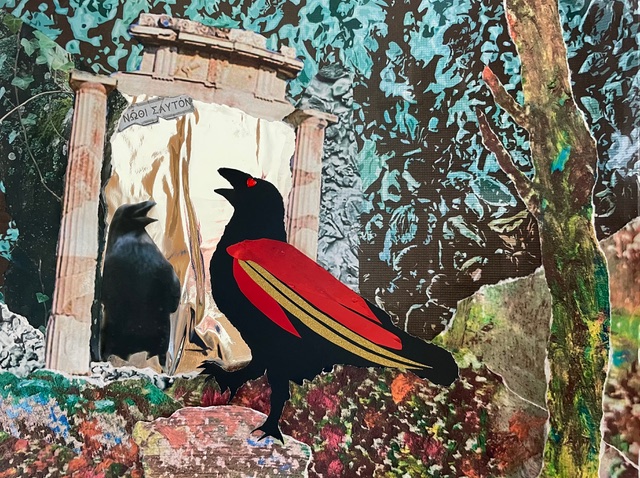
To learn the difference, we can revert to the age-old adage ‘Know Thyself’. According to history, ‘Know Thyself’was inscribed on the Temple of Apollo in Delphi as important advice. This wisdom has withstood the test of time for good reason. Few things are more important and more difficult than this life lesson. Had the raven known itself, the story would have ended differently. If he had been aware of the limitations that come with being a ‘crow’, he would have been immune to the excessive praise. A crow can do a lot, but not everything. He is not a miraculous bird. He would have flown off and could have enjoyed the cheese undisturbed in another tree.
“Look carefully and honestly in the mirror”
The real lesson of the fable is therefore to regularly consult yourself and look inward attentively and honestly, holding up a mirror to yourself. By looking in the mirror, you are confronted with your own shortcomings. However, the question remains whether self-knowledge is even attainable in this way, aside from the spiritual aspect of the aphorism, of course. Many well-known philosophers have pondered this question. To begin with, Socrates. His adage was: Self-knowledge is the beginning of all wisdom. He recommends gaining insight step by step through asking the self questions. In practice, this proves to be quite difficult. Self-deception, blind spots and emotional distortion are pitfalls, just as with the raven who thinks it is great and spectacular. Does he really want to know what the mirror shows him? This requires lifelong practice and often painful insights. According to Aristotle, you cannot know yourself directly at all. You always see yourself in a mirror image; it is an inverted reflection of reality. Another person sees you as you can never see yourself. In other words, it always requires someone else. And not just anyone. It takes a true friend who tells it like it is, without being blunt. Someone who does not say what you want to hear out of politeness, or who has a hidden agenda, like our clever fox. Responding well to honest feedback is also an art. Self-knowledge requires courage, especially when you discover that you are less fantastic than you hoped.
The moral of this age-old fable is beyond doubt: Do not let yourself be manipulated and charmed by flatterers. A challenging task, because who is not sensitive to some form of flattery? It is nice when someone says something positive about, for example, your work; it is encouraging. On the other hand, doubts about the truth are also justified and necessary. Is this correct? Is it sincere or said just to be nice or to get something done? Flattery is sometimes so subtle that you do not notice it. A grandmother who does not say, ‘That sounds fun, don’t you want to take singing lessons?’ but does say, ‘Could you sew this button on for me, you’re so good at it?’
Even in our time, this fable is relevant. And certainly not only in personal relationships. Think of politics and power, advertising and marketing, and social media where likes are quickly given. Everywhere flattery is used, a ‘piece of cheese’ is at risk. That piece of cheese means something different to everyone, and there is always potential loss.
In The Raven and the Fox, the cheese is the catalyst that has increased the raven’s self-awareness. By losing it, he realises that he has been tricked, which is a painful realisation. Hopefully, it will not happen to him again. If all goes well, he has undergone a transformation. ‘Know Thyself’ is not only a call to introspection, it also demands change through awareness.
These are important life lessons wrapped in a light-hearted animal story.
And that is why reading and reflecting on fables is still both useful and enjoyable.
Notes
[1] Jean de La Fontaine (nagevolgd door J.J.L. ten Kate) – De fabelen van La Fontaine – Amsterdam, Gebroeders Binger, 1875 (?) (1e druk). Geïllustreerd met platen en vignetten door Gustave Doré. Fabel II, eerste boek, pp. 7-8.
[2]Het leven en de fabels van Esopus. Teksteditie met inleiding, hertaling en commentaar door Hans Rijns en Willem van Bentum. Hilversum: Verloren, 2016, p. 179 .